When God breathes life into what the world has already given up on.
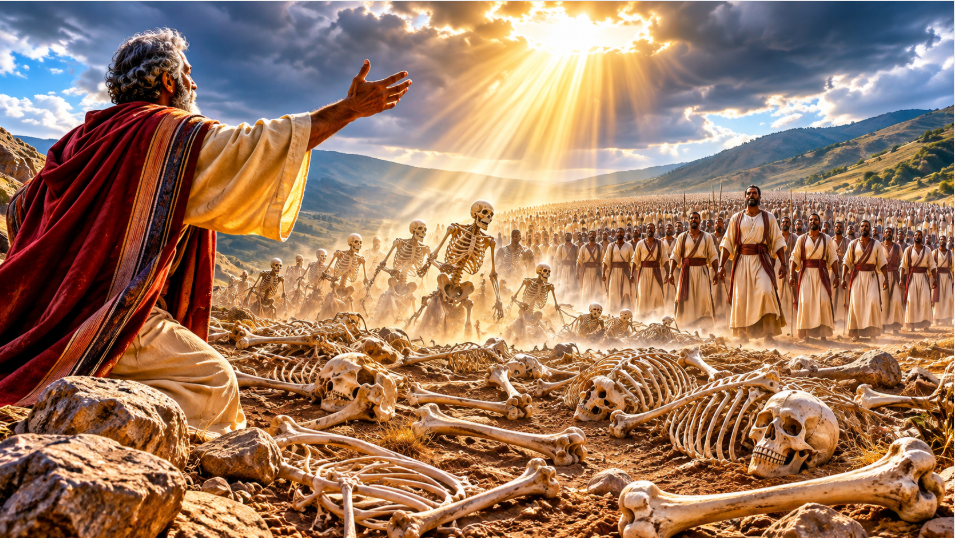
Imagine walking through a valley filled with human bones.
Not one or two. Thousands of them.
No flesh. No skin. No heartbeat. No movement. Just bones scattered across the ground, exposed to the scorching sun.
There is no hospital to rush them to. No doctor to call. No ambulance coming. There is absolutely nothing humanly possible that can bring them back to life.
And then God asks you a strange question:
“Son of man, can these bones live?” — Ezekiel 37:3 (KJV).
What would you say?
Would you look around, examine the situation and conclude that it is impossible? Would you laugh at the question? Or would you, like Ezekiel, surrender the answer to the One who created life in the first place?
Ezekiel answered:
“O Lord GOD, thou knowest.”
And that is where one of the most extraordinary stories in Scripture begins.
When life becomes a valley of dry bones.
The story in Ezekiel 37 is not simply about a strange vision. It is about a nation that had lost hope.
Israel was broken. Its people were scattered. Their future looked uncertain. Their confidence had collapsed.
In Ezekiel 37:11, the people themselves expressed their despair:
“Our bones are dried, and our hope is lost: we are cut off for our parts.”
Have you ever reached a point where those words describe your life?
You have tried, but nothing seems to work.
You have prayed, but the answers seem delayed.
You have invested your time, energy and resources, but the results are nowhere to be seen.
Perhaps it is a business that is struggling, a career that has stalled, a family going through difficult seasons, a dream that seems to have expired, or a relationship that has lost its warmth.
Sometimes, the most painful thing is not that something has gone wrong. It is that you can no longer imagine how it could ever become right again.
That is what a valley of dry bones looks like.
But here is the first lesson: A situation can be beyond human repair without being beyond God’s power.
God does not ask for an explanation. He gives an instruction.
After showing Ezekiel the valley, God gives him an instruction:
“Prophesy upon these bones, and say unto them, O ye dry bones, hear the word of the LORD.” Ezekiel 37:4 (KJV).
Think about that for a moment.
God asks Ezekiel to speak to dead bones.
What sense does that make?
Bones cannot hear. They cannot respond. They cannot understand instructions. Yet God tells His prophet to speak.
Ezekiel could have questioned the instruction. He could have argued that speaking to living people was difficult enough, let alone addressing bones.
But he obeyed.
And this is where many of us struggle. We want God to explain everything before we take the next step. We want to see the outcome before we obey the instruction.
But faith sometimes requires us to act on God’s Word even when the circumstances make no sense.
You may not see the business opportunity yet, but you can prepare.
You may not see the breakthrough in your career, but you can remain diligent.
You may not see the restoration of your family, but you can continue choosing love, patience and prayer.
You may not see the answer, but you can remain faithful.
Do not allow what you see to make you disobedient to what God has said.
The sound of rattling bones: Restoration begins!
Ezekiel obeyed.
And suddenly, something extraordinary happened.
“And when I prophesied, there was a noise, and behold a shaking, and the bones came together, bone to his bone.” — Ezekiel 37:7 (KJV).
Imagine the scene!
The valley that had been silent for years suddenly became noisy.
Bones began moving. Scattered pieces started finding their rightful places. What was disconnected began coming together.
What a sight!
But notice something important: the restoration happened in stages.
First, there was a sound.
Then, there was shaking.
Then, the bones came together.
Then, sinews and flesh appeared, and skin covered them.
This is a beautiful reminder that restoration does not always happen in a single moment.
Sometimes, God begins by reconnecting things that have been scattered.
An opportunity comes. A forgotten relationship is restored. A new idea emerges. A door opens. A little progress appears where there was previously none.
It may not look like the final breakthrough, but something is happening.
Do not despise the beginning of restoration because it does not yet resemble the finished product.
A rattling valley is better than a silent graveyard!
Having a body is not the same as having life.
Here comes one of the most interesting parts of the story.
The bones had come together. The bodies had been formed. They had sinews, flesh and skin.
Everything looked complete.
But there was one problem:
“But there was no breath in them.” — Ezekiel 37:8 (KJV).
They looked alive, but they were not alive.
This is perhaps one of the most important lessons of the entire vision.
You can have everything that looks like success and still lack what makes life meaningful.
You can have a good job but no peace.
You can own a business but lack purpose.
You can have money but lack contentment.
You can occupy a position of leadership but lack integrity.
You can have a beautiful house but a broken home.
You can have a crowded calendar but an empty soul.
The appearance of life is not necessarily the presence of life.
Ezekiel’s vision reminds us that we need more than external restoration. We need the breath of God.
God therefore instructs Ezekiel to prophesy to the breath:
“Come from the four winds, O breath, and breathe upon these slain, that they may live.” — Ezekiel 37:9 (KJV).
And the breath entered them.
They lived!
The lesson is simple: Do not become so preoccupied with building the outward appearance of success that you forget the spiritual foundation that sustains it.
Invite God into your plans, your ambitions, your family, your work and your decisions.
We need more than things coming together. We need God to give them life.
From scattered bones to a Great Army!
Now comes the climax.
Ezekiel 37:10 records:
“So I prophesied as he commanded me, and the breath came into them, and they lived, and stood up upon their feet, an exceeding great army.”
Stop and picture that transformation.
The same valley.
The same bones.
The same place that once represented hopelessness.
But now, instead of a valley of death, there stands an exceedingly great army!
God did not merely restore the bones to their original condition. In the vision, they became a mighty army.
What a transformation!
The bones that could not move were now standing.
The bodies that had no breath were now alive.
The scattered remains had become a united force.
And this is the beautiful truth: God’s restoration is not about helping us merely survive. It is about bringing us back to life for His purpose.
The army was not raised simply to admire its own existence. It represented the restoration of God’s people and their hope.
Sometimes, the thing you are going through may become part of the testimony through which you encourage someone else.
Your experience can become wisdom.
Your disappointment can become a lesson.
Your struggle can deepen your compassion.
Your restoration can inspire someone who has almost given up.
Never underestimate what God can do with a life that has surrendered to Him.
What if your valley is not the end of your story?
Perhaps you are reading this while standing in your own valley.
Maybe you are wondering how a particular situation will ever change.
Perhaps you have buried certain dreams because you believe their time has passed.
Maybe you have reached a point where you have stopped expecting anything good.
I want you to remember the question God asked Ezekiel:
“Can these bones live?”
The question was not whether Ezekiel could make them live.
It was whether the situation was beyond God’s ability.
And the answer was demonstrated right there in the valley.
The same God who spoke through Ezekiel is the God who created the heavens and the earth. The God who formed Adam from the dust of the ground and breathed into his nostrils the breath of life.
He is not limited by the circumstances that limit us.
However, this is not a promise that every situation will unfold exactly as we desire or according to our timetable. The vision was specifically given to Israel as a promise of national restoration.
But its message of God’s power, faithfulness and ability to restore hope remains deeply encouraging.
Our responsibility is to trust Him, obey His Word and remain faithful, even when the valley looks lifeless.
The final lesson: Never confuse a valley with a destination.
There is something remarkable about Ezekiel 37.
God deliberately takes Ezekiel into the valley. He does not show him a beautiful garden or a flourishing city. He shows him death, destruction and hopelessness.
Why?
Perhaps because sometimes we need to see the full extent of a situation before we appreciate the greatness of God’s power.
But the valley was not the final destination.
It was the setting of a testimony.
The bones were not the end of the story.
The army was.
And perhaps that is the perspective we need to carry into our daily lives.
Do not allow a difficult season to define your entire future.
Do not allow one failure to become your identity.
Do not allow temporary disappointment to bury a God-given purpose.
Do not allow the absence of visible progress to convince you that God has abandoned you.
The valley may be real, but so is the God who can restore.
A WORD TO CARRY WITH YOU.
The next time life places you in a valley, remember Ezekiel.
Remember the sound of the rattling bones.
Remember the shaking.
Remember the bodies coming together.
Remember the breath entering them.
And above all, remember the army that stood where death once reigned.
You may be looking at scattered bones today, but do not forget who holds the power to give life.
The story does not have to end where hope appears to have died.
“And shall put my spirit in you, and ye shall live, and I shall place you in your own land: then shall ye know that I the LORD have spoken it, and performed it, saith the LORD.” Ezekiel 37:14 (KJV).
From dry bones to a great army. From hopelessness to restoration. From silence to a testimony of God’s power.
May we never lose faith in the God who makes the impossible possible.
God leads my way.
No responses yet